Every B2B sales team needs an edge — and Gong promises to give you one with an improved sales process based on cutting-edge revenue intelligence features.
Gong provides valuable insights from past sales calls, emails, and meetings, thanks to AI-powered data analysis. The platform helps you see where sales conversations went wrong or right, and fairly judge team performance.
However, as with any tool in your sales stack, two questions loom large:
- Does Gong improve your sales process in a meaningful way?
- Is Gong worth its price?
Unfortunately, the consensus seems to be "No."
Let's see exactly what the platform does, why users are opting for Gong alternatives instead, and which other tools are our top choices.
TL;DR
- Gong users often complain about its steep learning curve, unreliable support, and lack of transparent pricing.
- Bluedot emerges as the strongest Gong alternative with bot-free recording, automatic CRM integrations (Salesforce and HubSpot), and accurate multilingual transcriptions.
- Fireflies AI is good for teams seeking sentiment analysis and collaboration tools, but its credit system and capped meeting lengths can increase costs.
- tl;dv offers strong transcription accuracy and clean usability, but key sales coaching features are locked behind higher-tier plans.
- Otter.ai remains best for in-person meetings, though speaker tagging and AI analytics lag behind competitors.
- Notta provides straightforward AI transcription at a low cost but lacks deep sales intelligence and CRM connectivity.
- In terms of the price-to-value ratio, Bluedot’s Pro plan delivers the most flexibility and automation while costing a fraction of Gong’s enterprise pricing.
How Does Gong Work?
Gong is a “revenue intelligence” platform designed for B2B sales teams.
It helps sales teams by recording customer calls and emails, and then turning that raw activity into actionable insights and coachable moments.
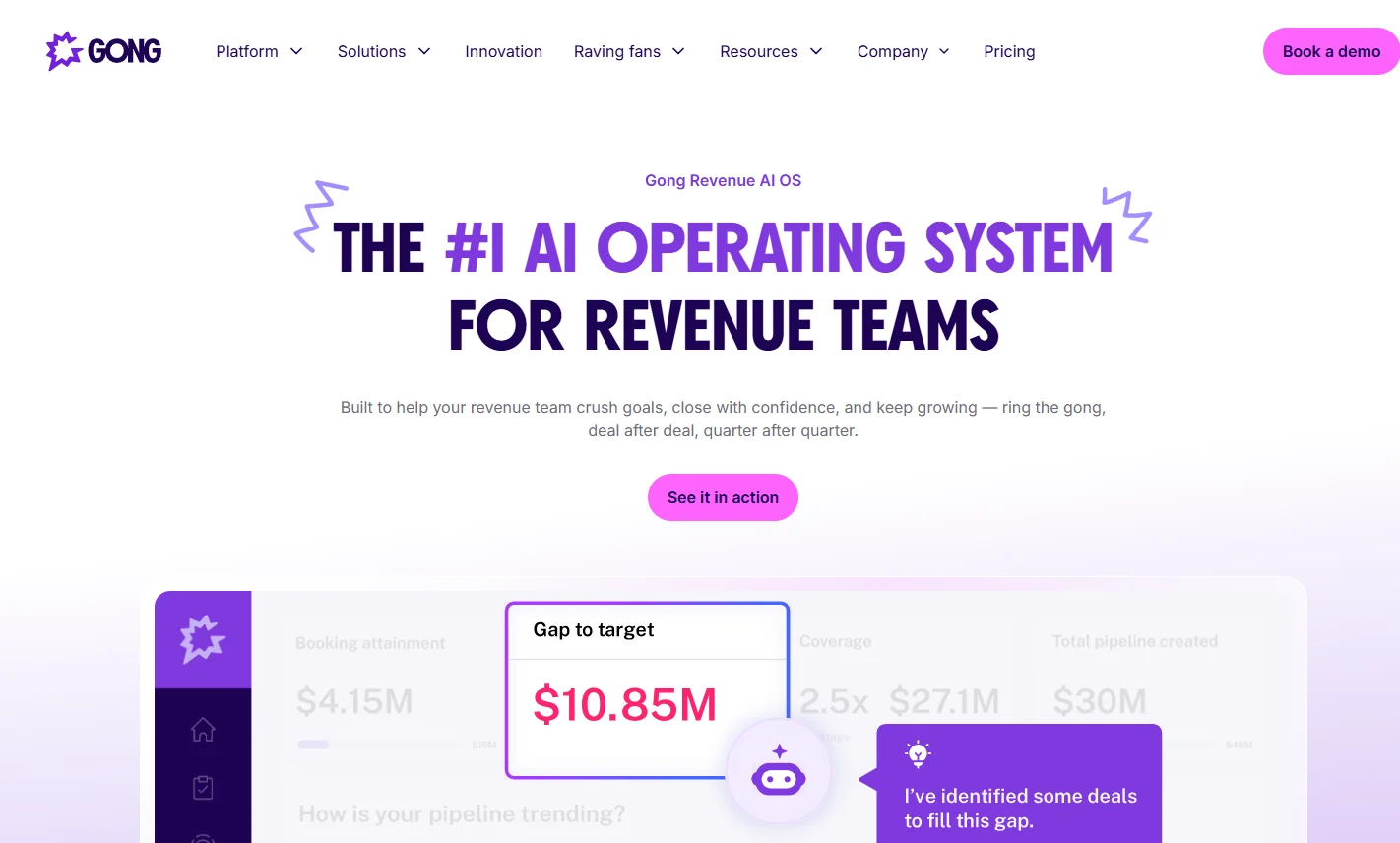
And while Gong likes to promote itself as an "AI operating system" for sales teams, it's just another sales platform in practice — not an entire OS, like Windows or macOS.
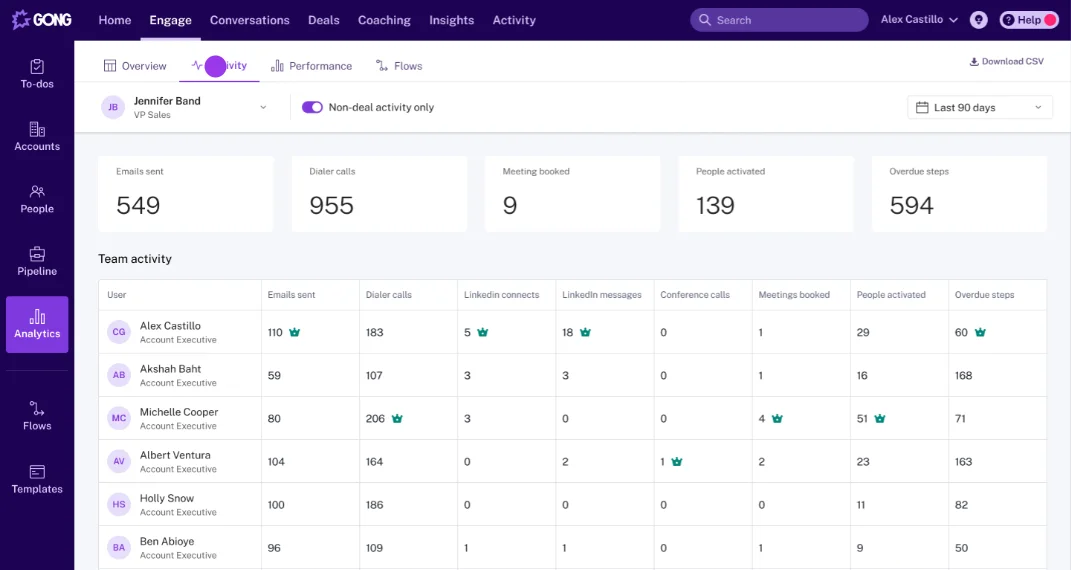
However, the fact that it's not an OS doesn't make it any less complex. Gong consists of three layers:
- Gong Forecast — Forecasting, pipeline health, deal-risk, roll-ups, and visibility into where your revenue is headed.
- Gong Enable — Coaching, training, measuring team behaviour, and correlating team actions with outcomes.
- Gong Engage — Outreach, follow-ups, flows, and task automation tied to interactions (calls/emails.
To build a full picture of your interactions with leads and customers, Gong integrates with CRMs, email platforms, calendars, and video conferencing software.
Using AI, it records and transcribes relevant conversations so you can search, review, and analyze them. Gong also uses AI to highlight important signals — like a deal stalling, or a customer asking about price.
Then, it presents relevant information to sales reps and managers, helping them improve their sales process. Gong can also automatically generate follow-ups and other communications via AI.
Sounds great — at least on paper.
In practice, using Gong is often more trouble than it's worth, especially for smaller sales teams. Let's see why.
Why Do You Need a Gong Alternative?
Considering all of Gong's advanced conversation intelligence features and pipeline management options, why do so many users opt for a Gong alternative?
Unfortunately, Gong has many core issues, including:
- Steep learning curve
- Subpar support
- Lack of transparent pricing
- Questionable business tactics
- Only a few practically useful features
- Call recording notification can feel intrusive
Before we recommend specific alternatives, let's dive into each problem with Gong in more detail.
#1. It's Hard To Use
On the surface, Gong seems to offer one of the most comprehensive revenue-intelligence suites available — especially if you want AI-powered automation.
However, reports from actual users paint a different picture. In practice, daily usability is a major concern for many teams.

For many users, Gong is too unintuitive and complex. And bear in mind, these are seasoned members of SMB sales teams — not random folks off the street.
Even for experienced sales reps, daily workflows are just too cluttered with Gong. Basic actions take too long, like locating recorded calls and navigating transcripts.
Obviously, this is an issue when you need access to reliable customer information fast — which is practically the only reason you’d want a platform like Gong in the first place.

Plenty of sales professionals are unhappy with Gong Engage, the platform’s outreach and sequencing module.
Users note that setting up engagement flows and tracking sequences is cumbersome, especially compared to dedicated outreach tools.
Since most sales teams look for automation without additional complexity, these difficulties with Gong Engage limit its appeal.

The most common complaint by far is information overload. Users have too many options, and the volume of available data is too large. On the other hand, your team isn’t likely to get the guidance it needs to build an efficient workflow with Gong.
#2. Customer Support Is Bad
Customer support is definitely one of Gong’s biggest weaknesses.
While the platform promises a full-service onboarding and enablement process, many users describe their experience as inconsistent, slow, and often outsourced.
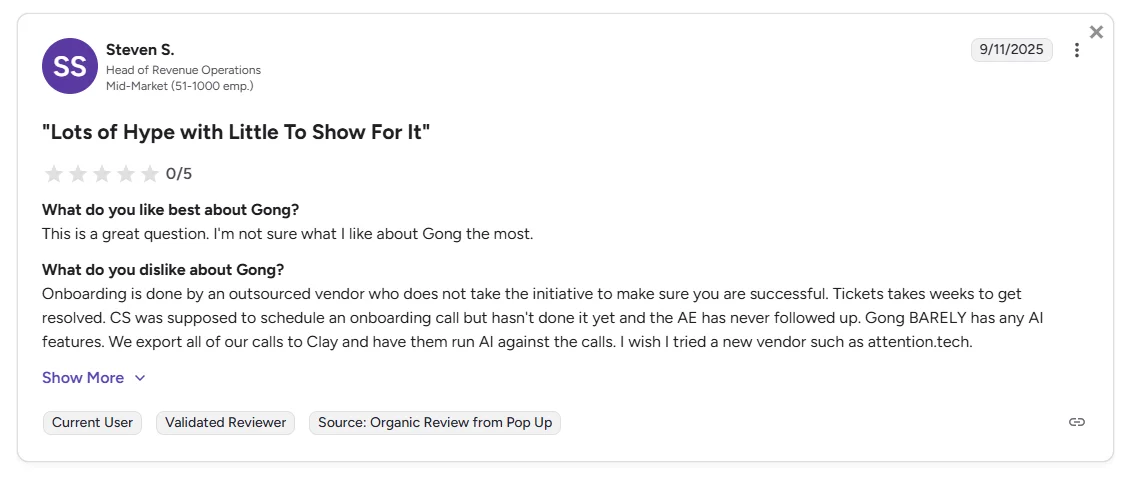
Several users report that onboarding isn't handled directly by Gong’s internal team but by third-party vendors who fail to follow up and ensure successful setup.
Reportedly, support tickets remain unresolved for weeks. Also, users are frustrated by the lack of proactive guidance during deployment. Most people expect more from a premium-priced, enterprise-oriented sales platform – and rightfully so.
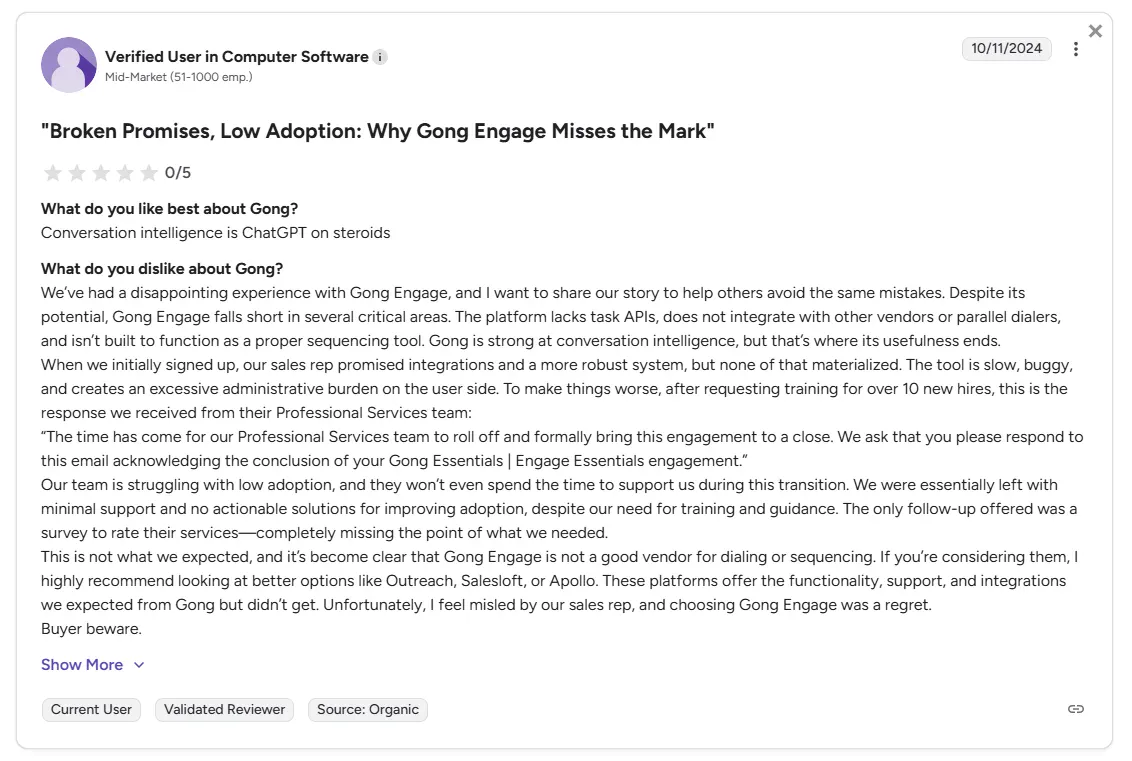
Beyond onboarding, the day-to-day support experience isn’t much better. Users often mention long delays in receiving responses.
Reaching a live representative seems too hard for a tool that charges such a premium price. In contrast, many AI tools with far lower subscription prices, like Bluedot, make it easier to reach actual support staff who often respond within minutes.
In Gong, automated or templated replies are common, with some users saying they never received meaningful resolutions.
Unresponsive support can seriously interrupt your sales workflow, especially if you have problems related to CRM integration. Such issues stall performance tracking — precisely the thing Gong is supposed to enhance.
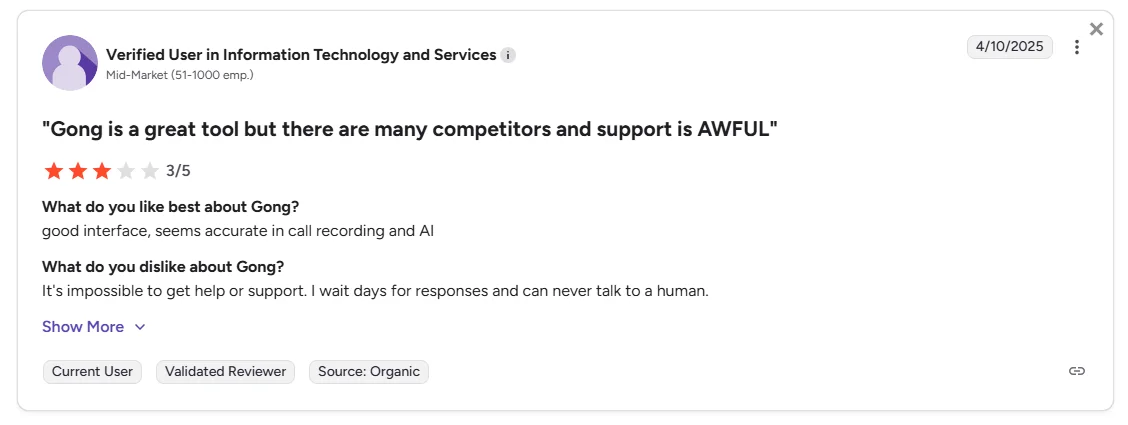
These issues are especially common with Gong Engage. Several teams attempting to train new hires or troubleshoot integrations found that Gong’s support team disengaged partway through the process.
If you're paying for enterprise software, you expect timely and informed assistance — especially if your sales team is learning how to use it.
#3. There's No Transparent Pricing
Gong does not publish pricing details on its website.
As a prospective customer, you have to submit company information — including team size, use case, and expected number of users — to receive a custom quote.
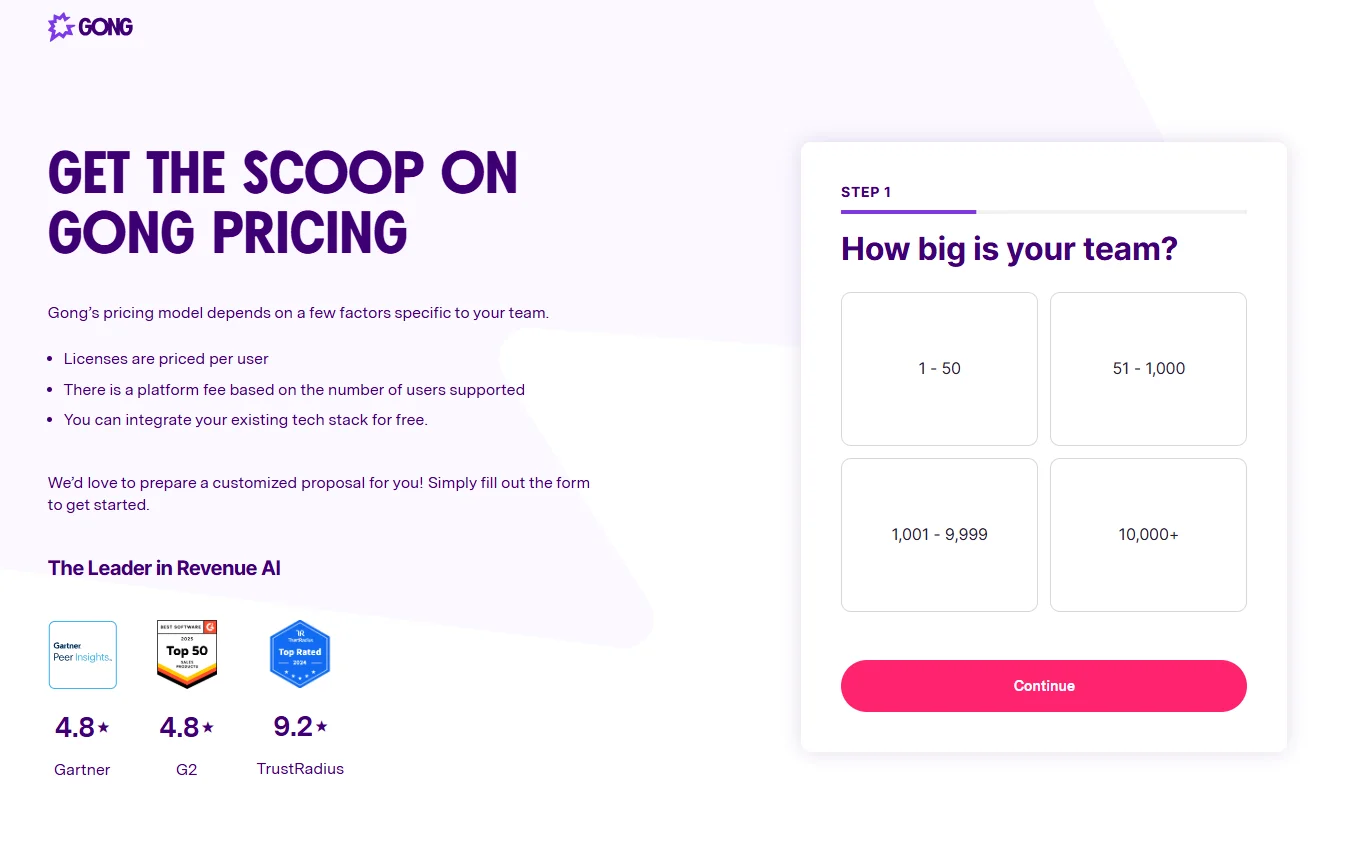
On one hand, this approach is common in enterprise SaaS. At this scale, costs depend on scale and required modules.
However, there's no denying that this practice makes decision-making harder for potential buyers.
Teams evaluating multiple platforms can't easily compare budgets or forecast total ownership costs — at least without entering Gong’s sales pipeline. Naturally, this slows down the procurement process for sales leaders, which isn't ideal when you're looking for a sales engagement platform.
Also, some similar CRM-adjacent tools for revenue teams at least provide some vague information — like per-seat ranges and estimates for the starting subscription tier. Gong's quote-only price model just isn't customer-friendly.
#4. The Company Isn't Always Aboveboard
When you're paying such an expensive subscription for a revenue intelligence tool, you're practically going into business with the software provider.
With that in mind, it is worth noting that some Gong users are dissatisfied with the company's business practices. Some of them have raised concerns about Gong’s sales approach.

In one case, a user claimed that Gong required a $9,500 minimum for a three-seat license paid upfront, which they found off-putting due to an overly aggressive pitch.
Naturally, experienced sales managers know that pressuring leads into commitments before fully explaining pricing structures or platform limitations isn't the best idea — especially when you're selling to other sales teams.
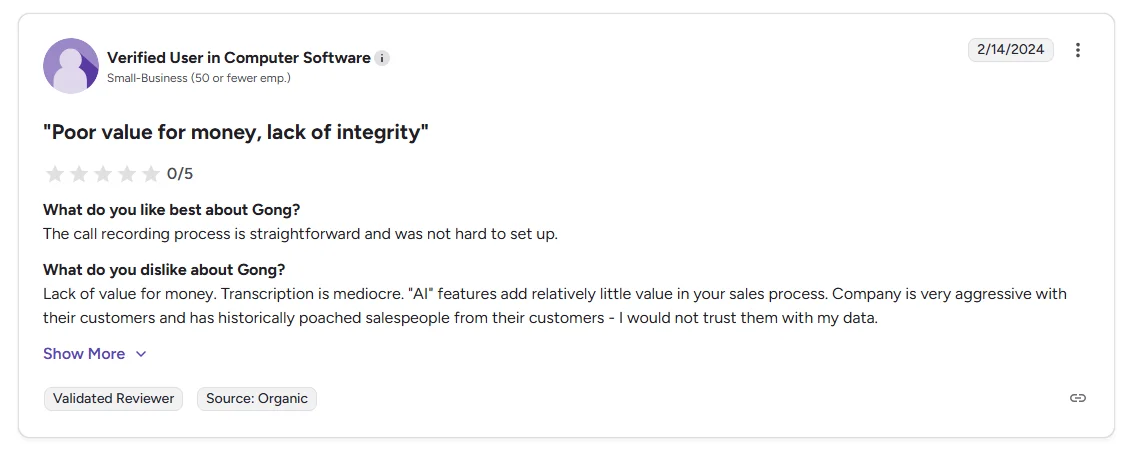
Additionally, at least one verified reviewer alleged that Gong has recruited sales professionals directly from client companies — obviously, a questionable business practice at best. While there's no way to verify these claims, hearing that stuff from verified reviewers is not a great look for Gong.
#5. Most People Just Use AI Summaries & Transcriptions
For many Gong users, only a few features are actually useful in practice: AI-powered meeting transcriptions and summaries, generated based on call recordings.
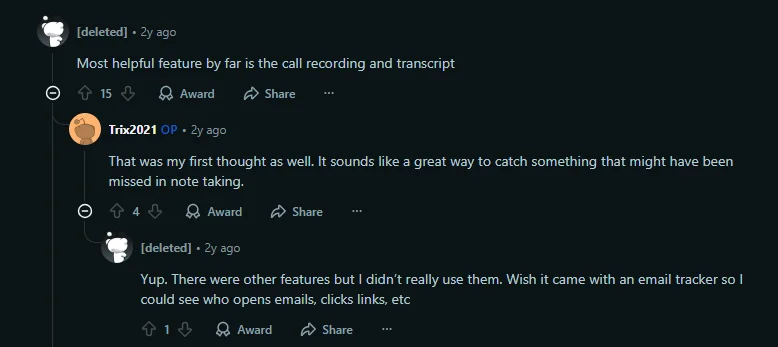
Several users note that the call recording and transcript tools are genuinely helpful for reviewing meetings and catching missed details.
However, Gong’s more advanced modules — such as Engage for outreach or email flows — are riddled with lag, frequent bugs, and freezing issues. One user described losing entire emails mid-draft and needing to restart the program multiple times per week.
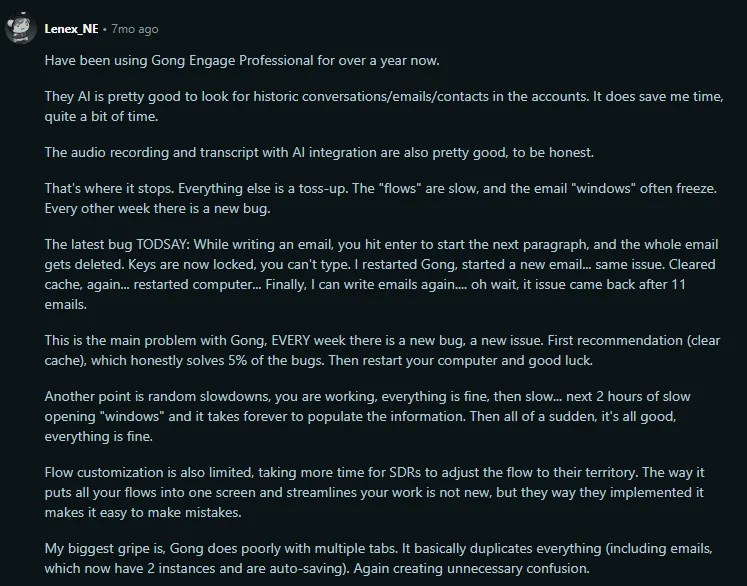
Based on many user experiences, it’s clear that the platform struggles with stability.
Reports often mention random slowdowns, duplicate windows, and tasks that take too much time to load.
Naturally, sales reps are frustrated because Gong is supposed to enhance productivity, not reduce it.
Because of these issues, many teams default to using Gong as a transcription and recording tool rather than a comprehensive revenue-intelligence platform.
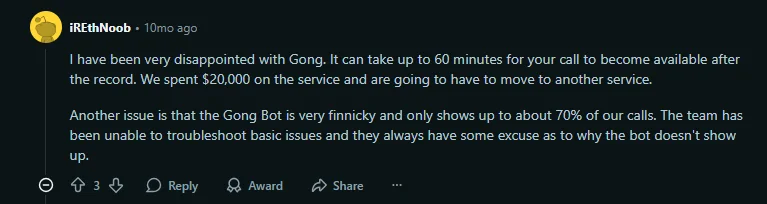
The main problem with using Gong as an AI meeting assistant is that it’s priced as an all-around revenue intelligence tool — remember its bombastic “AI operating system for revenue teams” claim.
In comparison, dedicated AI meeting tools like Bluedot or Fireflies AI cost significantly less.
When you can get the most useful functions of Gong in a lighter, lower-cost tool, the ROI becomes questionable.
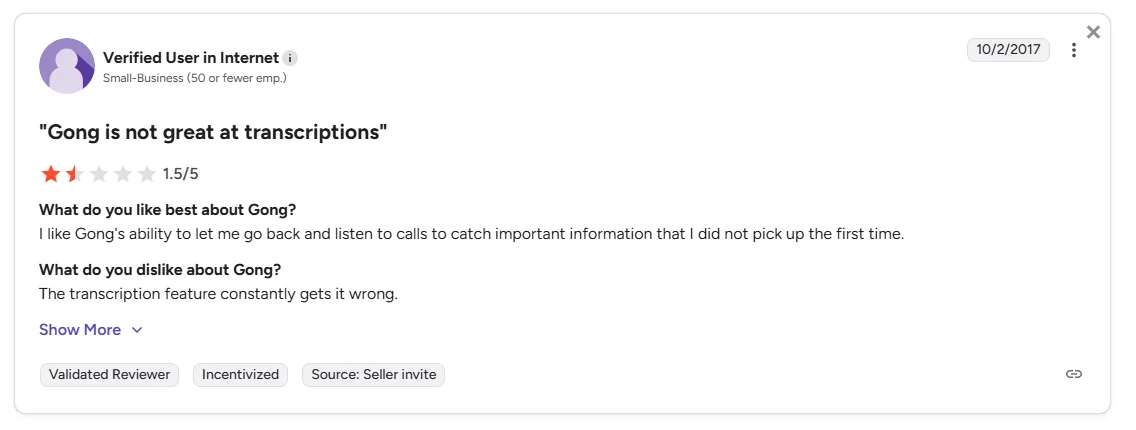
On top of all that, Gong doesn’t even guarantee you a reliably accurate transcription.
Some users report that transcriptions are inaccurate or inconsistent, with AI occasionally misidentifying speakers or missing key phrases.
#6. It Can Feel Intrusive To Prospects
Many Gong users mention that the platform’s call recording notice can interrupt or change the tone of sales calls.
When a meeting starts, Gong automatically announces that it’s recording — something like “Gong is in the room.”

This message is meant to follow privacy and data-protection laws, but it often makes prospects uncomfortable.
Some users say clients become quiet or hesitant once they hear the announcement, which can make it harder to build trust or have a natural conversation. Obviously, this is less than ideal for a small sales team or a dedicated account manager who’s trying to maintain trust.
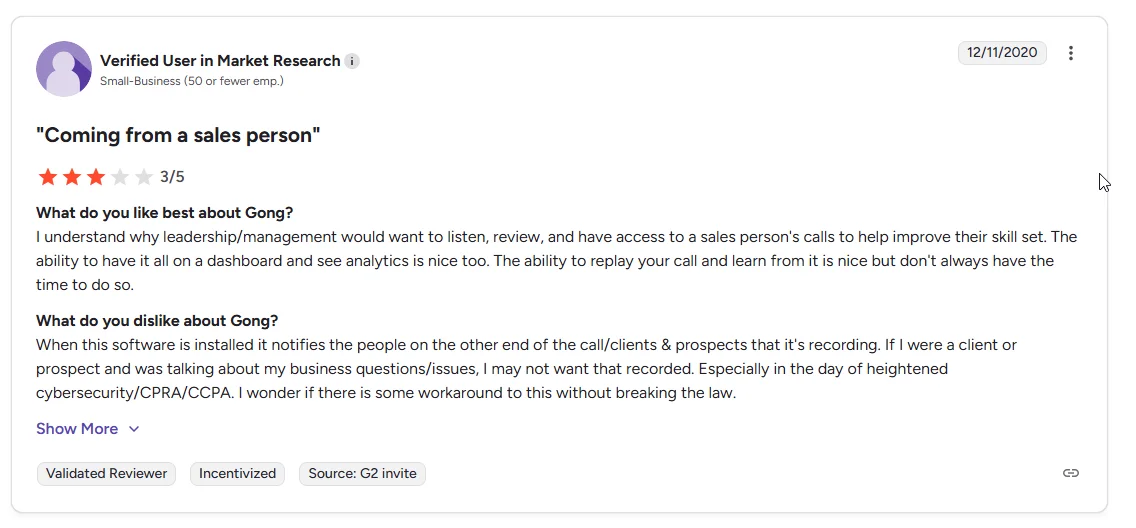
Other reviewers point out that while these alerts are legally required, the way Gong delivers them is more intrusive than necessary. Competing tools often use a small visual notice or request consent ahead of time, so the process feels less awkward.
For sales teams, a more discreet online video recorder would be more useful — especially if it can also transcribe and summarize calls.
Which Are The Best Alternatives to Gong?
Okay, so Gong isn't your most cost-effective choice for what it does best — providing conversation intelligence to sales teams interested in AI tools.
The question is — what's the ideal Gong alternative, if you want deeper insights and AI features at a lower price?
After plenty of testing and deliberation, our top 3 Gong alternatives are:
- Bluedot
- Fireflies.ai
- tl;dv
Let's see how each tool compares to Gong.
#1. Bluedot — Top Gong Alternative Overall

Bluedot is an AI-powered meeting assistant that records calls in Google Meet, Zoom, and Microsoft Teams, then produces searchable transcripts and meeting summaries.
The important part for sales teams — it syncs easily with major CRMs like Salesforce and HubSpot. You can easily import information from meetings recorded with Bluedot into the relevant deal pages and profiles on those platforms, in just a few clicks.
Also, it supports bot-free recording, so prospects don't have to know you're capturing the call in Bluedot.
Let's explore how it compares to Gong in more depth.
Gong vs. Bluedot — Essential Features
Where Gong overwhelms many users with complexity, Bluedot focuses on simplicity and AI automation.
With the Bluedot, you don't have the awkward “recorder in the room” problem that many Gong users cite. As a result, you can have a more natural conversation with a prospect, and ultimately close more deals.
Your sales reps can record and review meetings without disrupting rapport or alerting prospects mid-call.
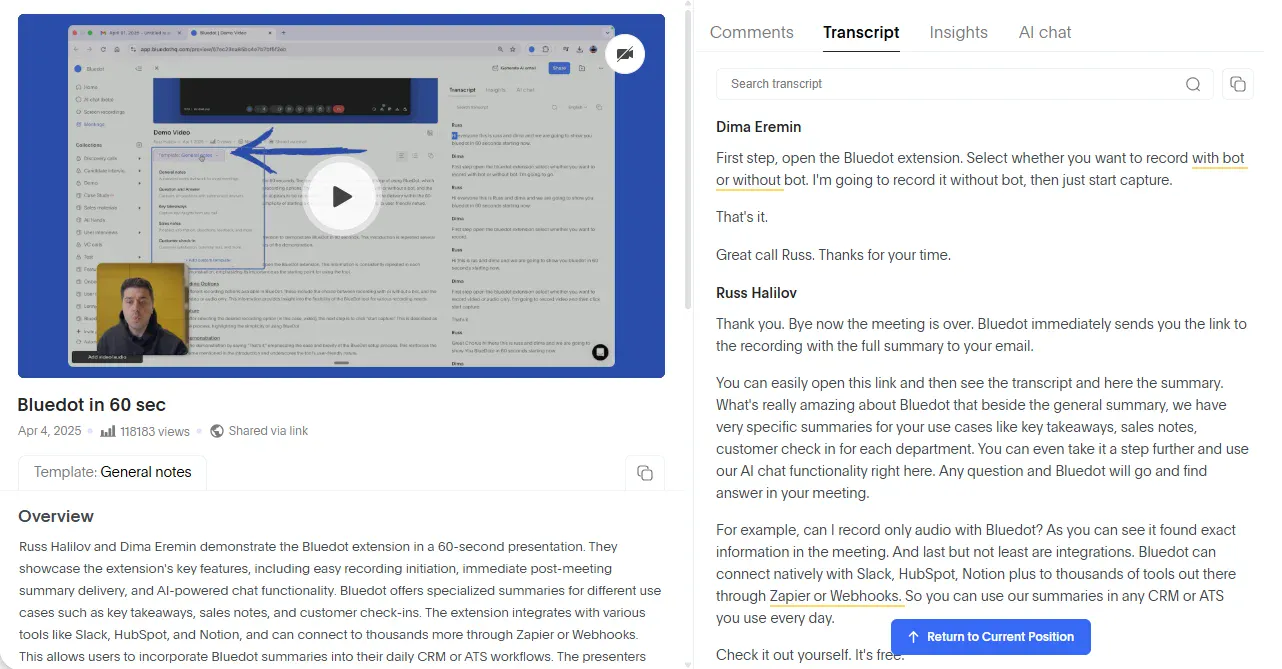
In terms of usability, Bluedot’s interface and workflow are simpler. Customer feedback shows that it simply works in the background, avoiding the clutter and information overload that frustrates many Gong users.
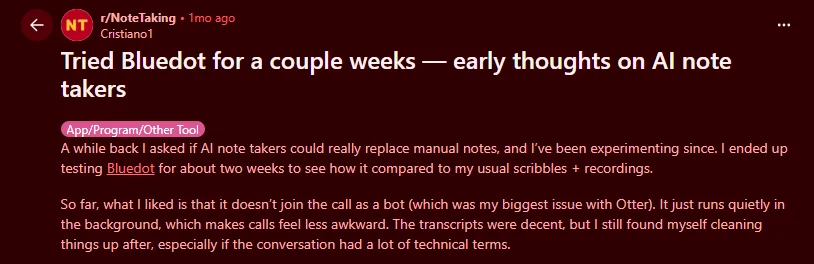
For small to mid-sized sales teams, this simplicity is a major boon compared to the steep learning curve that typically comes with enterprise tools. Plus, the platform's AI summaries provide all the deal intelligence and information on customer interactions you need. And you can easily export the information to your chosen CRM.
Customer support also earns consistent praise. Multiple users describe the support team as amazing and responsive — a sharp contrast to Gong’s frequent reports of delayed or outsourced onboarding.
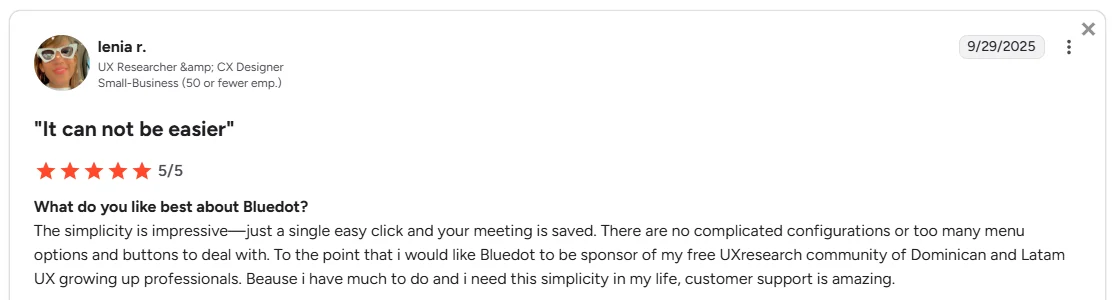
Reliable customer support helps Bluedot's users deploy faster and learn all the features quickly without interrupting workflow. This is a huge advantage for enterprise teams with tons of reps who need to start using the platform quickly.
Pricing transparency is another notable difference. Gong hides its costs behind quote requests, but Bluedot offers a clear pricing outline with its core features listed publicly on its official website.
This makes budgeting far easier for mid-market teams and helps them avoid the uncertainty of custom enterprise pricing.
Gong vs. Bluedot — Transcription Accuracy
Bluedot does fewer things than Gong, but ultimately does them better. Its core features — recording, transcription, and summarization — are stable and accurate across more than 100 languages.
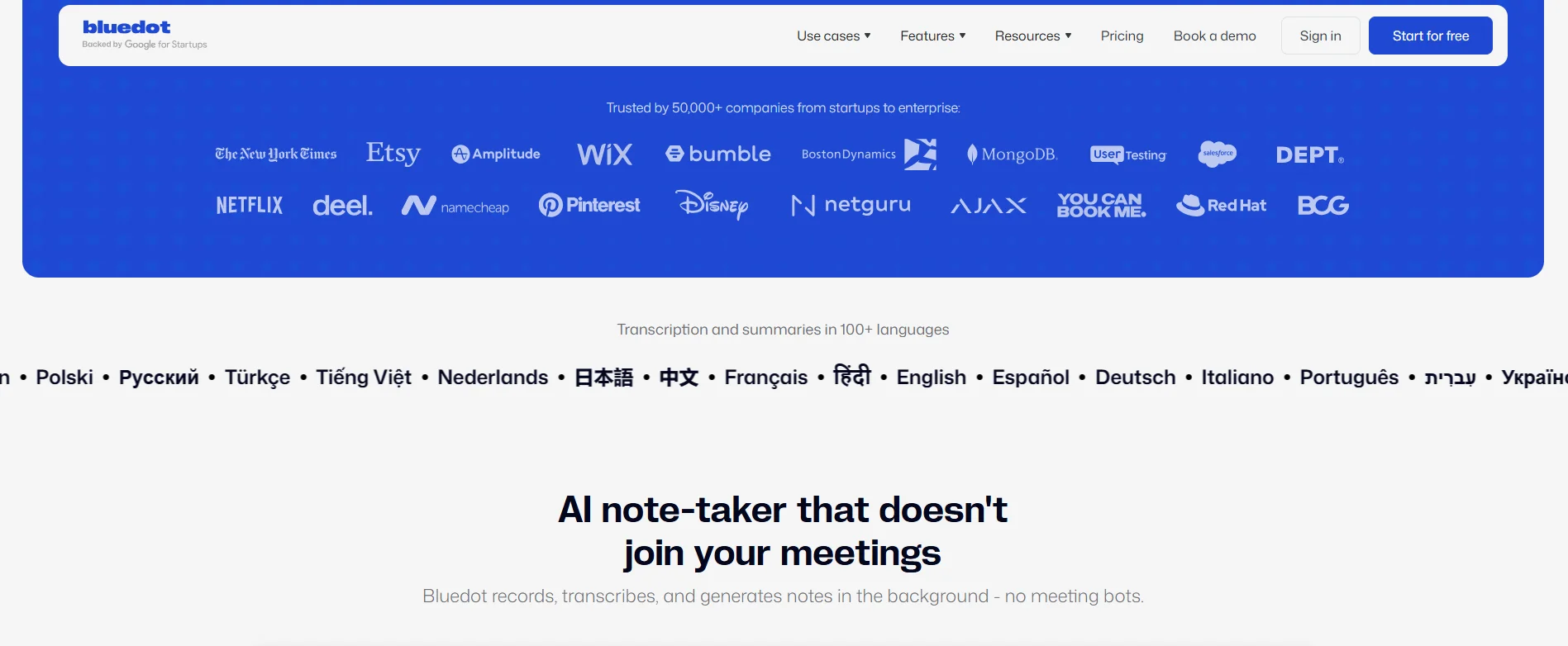
Users occasionally mention fine-tuning technical terms, but that’s a minor trade-off for a clean, lightweight system that avoids Gong’s lagging or buggy modules.
While Gong positions itself as a full “revenue intelligence” suite, many teams find that they only use its transcription and summary features. And it doesn't always analyze sales calls accurately, or support you throughout the entire sales process.
Bluedot delivers the essentials via accurate transcripts and AI meeting summaries, with a cleaner UI, clearer pricing, and stronger support.
Bluedot Pricing Explained
Bluedot Pros and Cons
Still not sure if Bluedot is a better deal than Gong? Keep this in mind:
#2. Fireflies.ai
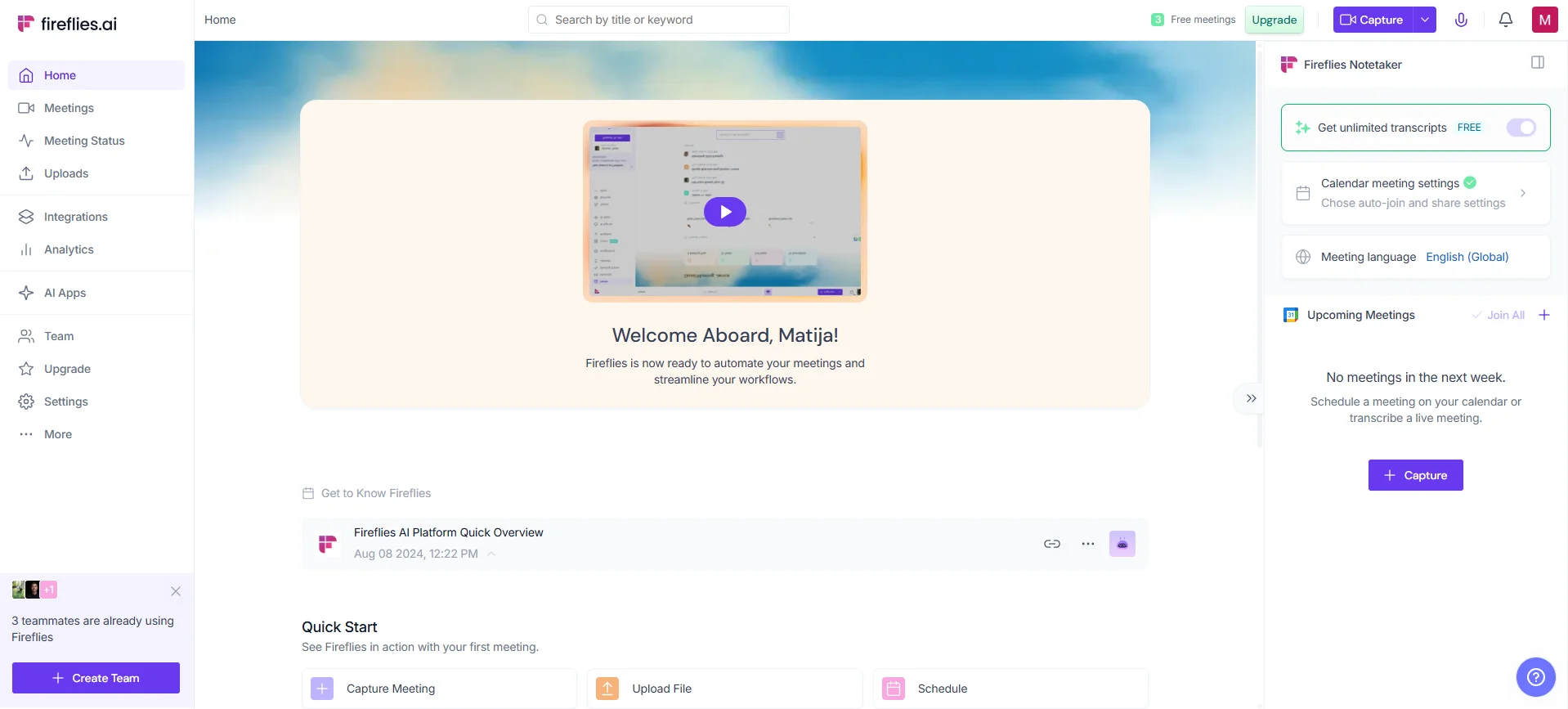
Like Bluedot, Fireflies.ai is an AI meeting assistant that records calls on Zoom, Google Meet, MS Teams. It can then transcribe them and produce summaries and action items.
Fireflies AI is known for its sentiment analysis features, making it useful for sales teams looking for subtle deal insights in key moments across all conversations.
Let's see if these unique engagement metrics make Fireflies a viable Gong alternative.
Gong vs. Fireflies AI — Ease of Use & Customer Suport
Where Gong users report a cluttered interface and steep learning curve, Fireflies is relatively straightforward. The tool joins meetings automatically, saves recordings to a searchable library, and transcribes conversations within minutes.
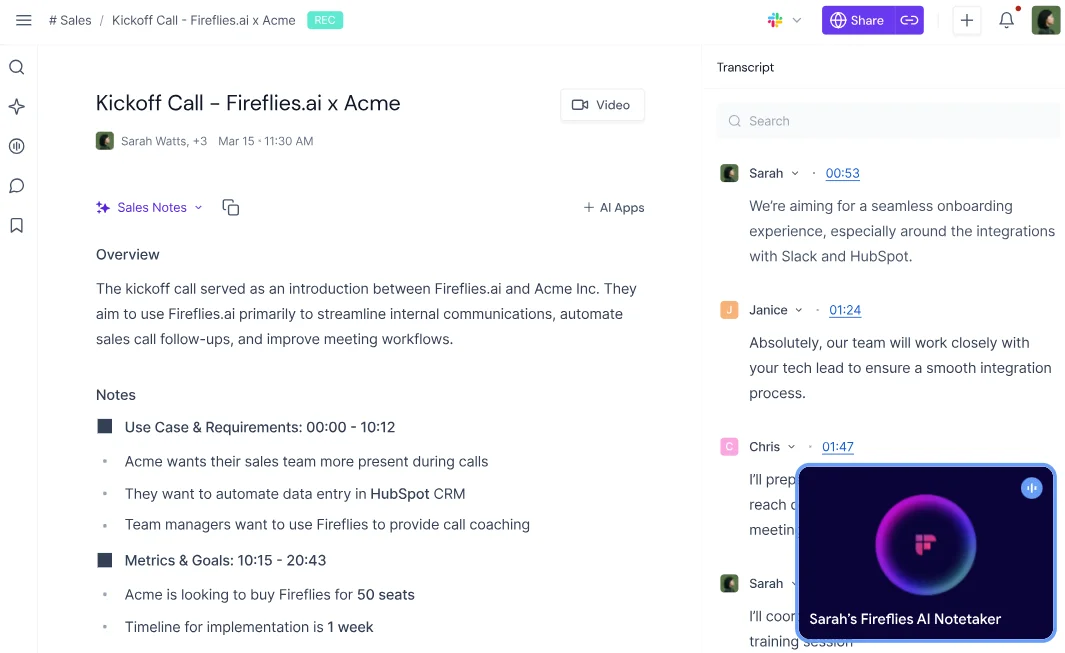
This makes Fireflies easier to integrate into your sales team's existing daily workflow.
Still, some users note that the app’s interface can feel slow when handling large transcripts, so performance may vary with heavy usage.
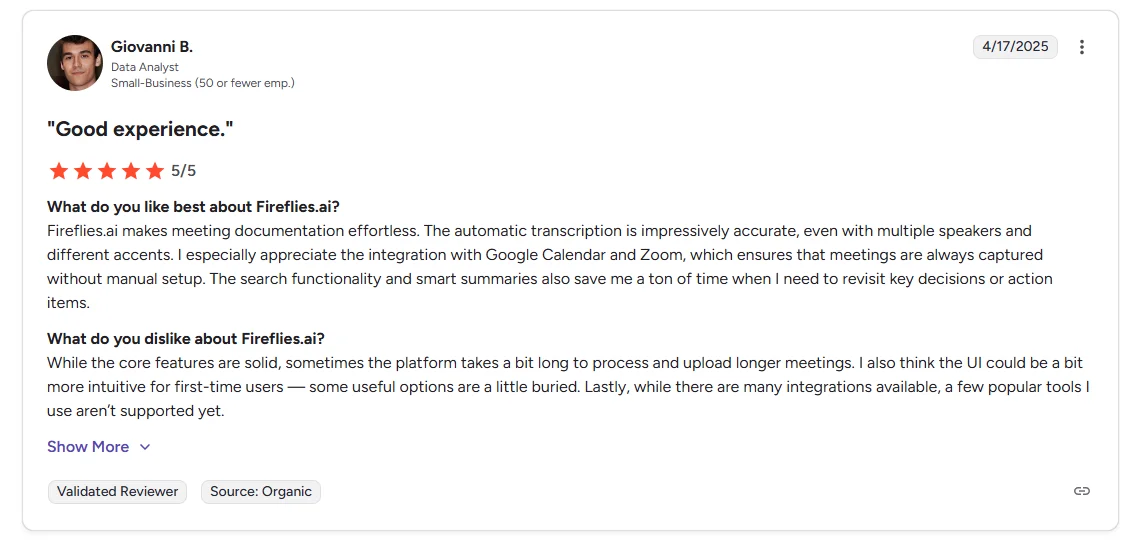
This can be an issue for anyone who handles hundreds of customer calls regularly, like sales teams and customer success staff.
When it comes to support, user experiences paint a mixed picture. Many reviewers appreciate Fireflies’ fast responses and clear setup instructions. Others mention slow ticket resolution and limited live-chat availability.
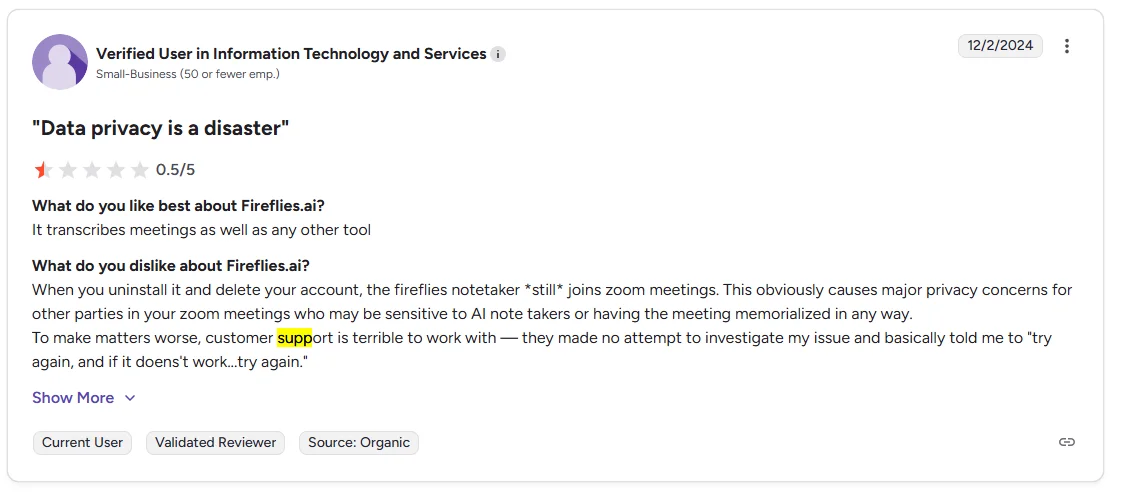
Overall, Fireflies AI support seems more accessible than Gong’s reportedly outsourced staff. However, it doesn't reach the level of real-time human support found in tools like Bluedot.
Gong vs. Fireflies AI — Pricing Transparency and Accuracy
Fireflies lists all of its pricing plans publicly — including Free, Pro, Business, and Enterprise tiers. As a result, your own revenue operations don't have to worry about the pricing uncertainty that comes with tools like Gong.
However, Fireflies runs on a credit-based system with per-user limits and team caps — and everything you do on the platform costs you credits.
So, if you want to analyze speaker talk time or get insights about the entire meeting lifecycle, you have to spend a certain amount of Fireflies credits. As a sales team, you'll probably hit your collective cap pretty soon — and additional credits are expensive.
Also, some users claimed they were overcharged by Fireflies AI for multiple subscriptions, and the platform's support staff wasn't particularly responsive.
In terms of AI coaching for your sales operations, Fireflies does a decent job. Its transcriptions and AI summaries are usually correct, and you can get useful deal risk insights from its sentiment analysis.
Fireflies AI Pricing Explained
At the end of the day, Fireflies is significantly cheaper and simpler than Gong — as long as you don't go above its credit limits. Here's an overview of the platform's various subscription options:
Fireflies AI Pros and Cons
Considering its pricey credit system, is Fireflies AI your most cost-effective Gong alternative? Consider the following pros and cons before subscribing:
#3. TL;DV
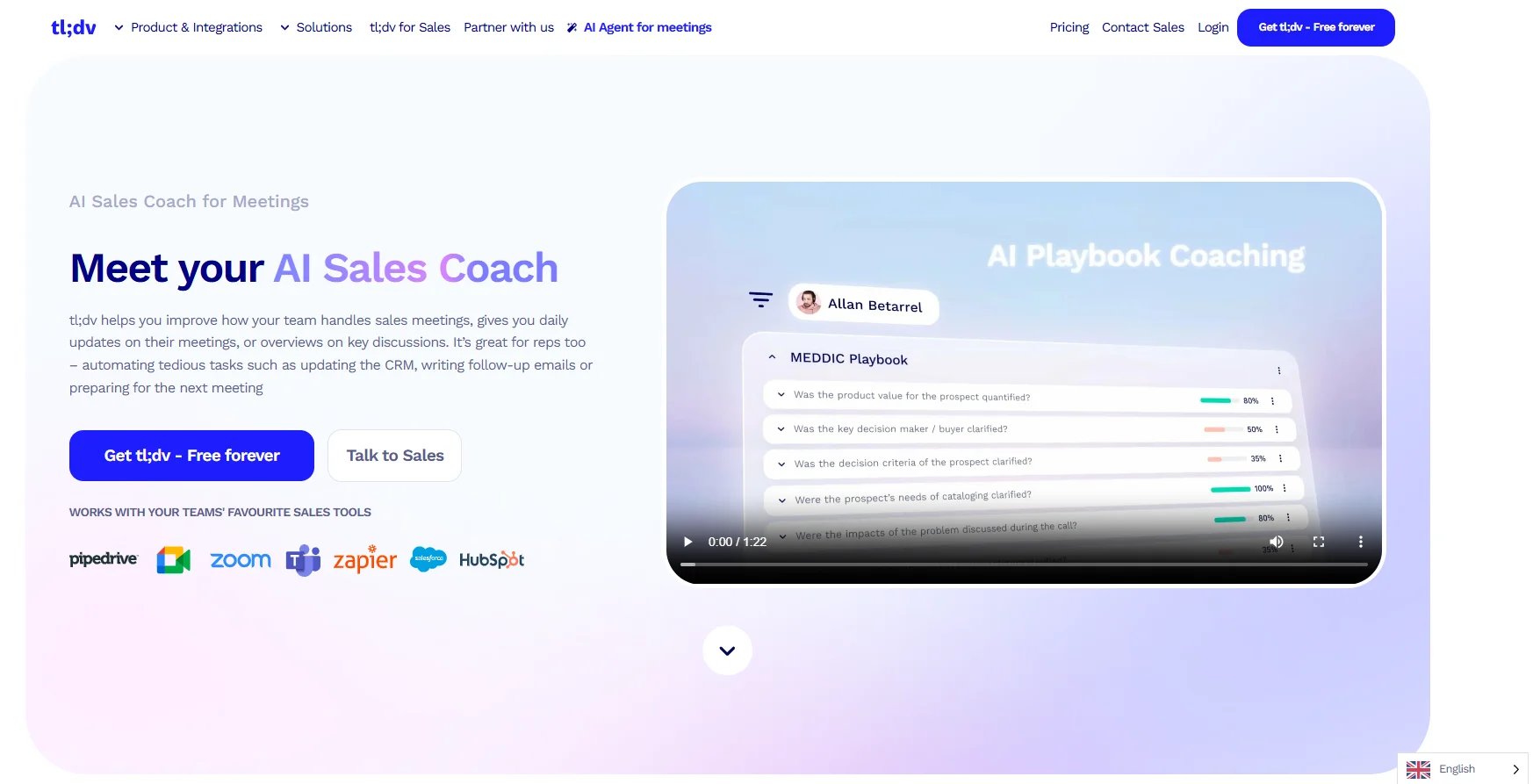
tl;dv is another AI-powered meeting recorder compatible with Google Meet, Microsoft Teams. Like our previous choices, it can help you streamline sales via automatic transcriptions and AI summaries with conversation intelligence.
However, its AI Coaching Hub with the most practical revenue intelligence features is locked behind tl;dv's priciest Business subscription — potentially making it an expensive choice for sales coaching.
Is it the right Gong alternative among competing AI meeting assistants? Let's find out.
Gong vs. TL;DV — Sales Coaching and Deal Management
tl;dv has a few unique features that make it easier for small teams to quickly review sales calls — stuff that Gong sorely misses.
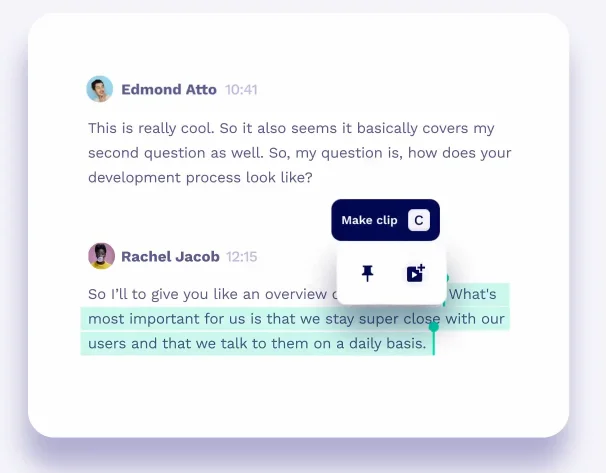
For instance, you can create short highlight clips of key meeting moments in a few clicks, simply by selecting a specific part of the transcript.
Then, you can easily share them with teammates or sales managers who didn't attend the meeting — keeping everyone up to date and making pipeline management simple.
Unfortunately, tl;dv supports only around 30 global languages for transcription and summaries — a far cry from Bluedot's 100+ languages, for example.
However, transcription accuracy is great, and it can also help you speed up follow-up tasks via integrations with Slack and Notion. This makes TL;DV a decent choice for global teams, and one of our top alternatives to Gong.
Gong vs. TL;DV — Ease of Use and Customer Support
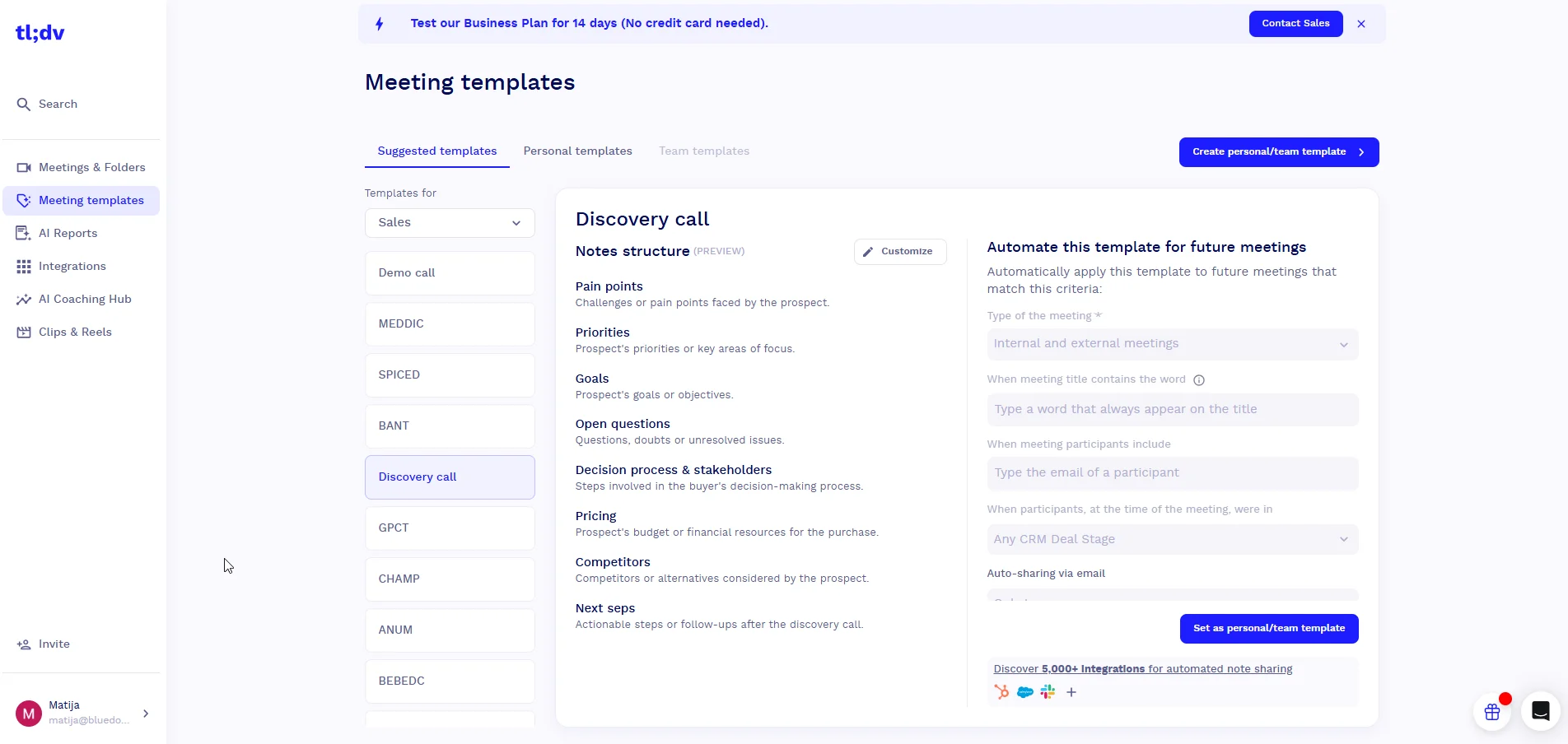
Compared to Gong’s confusing dashboard, tl;dv is clean and intuitive. While it's got limited conversation intelligence compared to Gong, tl;dv's AI meeting reports with sales templates often provide more valuable insights.
While tl;dv is easy to start using, there's no way to record meetings without a bot. The only alternative is to upload meetings recorded on other platforms. This can get a bit clunky, because it means constant sales team switching between different apps to get recordings and insights.
Also, this means your sales team will still have to talk to prospects who know they're being recorded — which is less than ideal.
On the other hand, users seem happy with customer support overall — although it sometimes takes up to 48 hours to respond, getting past the chat bot and speaking to a human is quick and easy. Also, there are tons of useful articles on tl;dv's Help Center, so you can solve plenty of small issues yourself.
TL;DV Pricing Explained
While Gong hides its pricing behind demo requests, tl;dv lists everything publicly. Crucially, tl;dv has a free plan with unlimited recordings and transcriptions — though access to AI summaries is limited.
Here's a full breakdown of the platform's pricing:
Bear in mind, however, that only the Enterprise plan allows for more than 3 simultaneous calls. In a busy sales team, you can easily hit that cap — making tl;dv potentially pricier than Bluedot or Fireflies for your use case.
TL;DV Pros and Cons
Not sure if TL;DV provides enough conversation intelligence options, considering its platform fees? Remember these advantages and drawbacks before making a decision:
How We Chose The Top Gong Alternatives
While evaluating the top Gong alternatives with conversation intelligence features, we took a long and hard look at how real sales teams use this type of software.
After trying out Gong ourselves, we researched the most common complaints from revenue teams around the world — on Reddit and verified review platforms, like G2 and Capterra. We focused on feedback from actual sales reps, and weeded out paid reviews and fake promotional materials.
Our goal was simple — find tools that do revenue intelligence better, for a lower price.
These days, that usually means AI meeting assistants that provide accurate transcriptions and real-time summaries. While those features alone might be enough for non-sales teams, most sales reps also use CRM like HubSpot and Salesforce. So, integration with those platforms was also a key point.
Ultimately, most contenders were evaluated on six criteria: ease of use, support quality, pricing transparency, transcription accuracy, CRM compatibility, and meeting privacy.
These categories mirror Gong’s biggest weaknesses, and we only considered platforms that addressed those issues.
We also prioritized tools that contribute something tangible to daily workflows, not just promise data analytics. That meant valuing lightweight automation and flexibility for both small and mid-sized sales teams.
At the end of the day, how quickly teams can deploy the platform after sign-up was crucial — and how much sales reps really used the platforms in practice.
What's The Best Gong Alternative For Sales Teams?
Bluedot stands out as the top Gong alternative for most sales teams. It addresses every major issue users report with Gong: complexity, slow support, intrusive recording, and hidden pricing.
Bluedot’s clean interface and bot-free recording give sales reps the freedom to speak naturally without making prospects uneasy. Its accurate transcriptions and AI summaries provide valuable conversation intelligence after every meeting.

Also, CRM integrations with Salesforce and HubSpot make data transfer seamless. You can automatically get meeting notes in your HubSpot deals and Salesforce task pages.
Support is another deciding factor. Gong users often complain about long delays or outsourced onboarding, but Bluedot’s team often responds within minutes, helping organizations deploy quickly. Plus, pricing is fully transparent, with clear tiers published online.
Ultimately, Bluedot does the best work on essentials — recording, transcription, summarization, and CRM sync. It isn't split into a bunch of confusing modules with overlapping features, and opaque enterprise-only pricing layered on top.
Rather, it's a simple tool with a browser extension that does everything you need. Even in the busiest sales team, it takes literal minutes to deploy and learn.
For small and mid-market companies, Bluedot offers everything Gong promises — without the steep learning curve, unpredictable billing, or forced enterprise lock-in.
Frequently Asked Question
Have more questions about useful Gong alternatives for remote teams? Here are answers to some common ones:
Who competes with Gong?
Some of the most common Gong competitors among revenue intelligence platforms are:
- Outreach
- Revenue.io
- Revenue Grid
- Chorus
However, these are mostly enterprise-level tools. Many small teams opt for AI meeting assistants like Bluedot or TL;DV, that provide core conversation intelligence functions without feature bloat and huge costs.
Is Gong AI free?
No, Gong is a paid platform without a free tier. The company does not publish fixed prices. Instead, it quotes custom proposals for every prospect based on their team size and other factors. Pricing consists of per-user licenses plus a platform fee.
Smaller-scale AI tools usually come with a free tier, or at least a free trial that lets you try out the platform's main features without paying.
How much does Gong cost per month?
Gong doesn’t list public per-seat prices. Officially, pricing is “per user” with an added platform fee and a custom quote. User reports on Reddit suggest as much as $16,000 per year for 8 seats (license plus platform fee) and minimum upfront fees in some cases.
However, these are unconfirmed, anecdotal claims — there's no way of knowing if they're true because Gong doesn't publish its prices publicly.
Is Gong a CRM tool?
No. Gong is a revenue intelligence platform that plugs into your CRM and communications stack to analyze customer interactions. Based on data from your conversations, it can produce deal insights and feed them into your CRM.
What CRMs does Gong integrate with?
Gong integrates with major CRMs, including Salesforce and HubSpot. The HubSpot integration can import fields (Accounts, Contacts, Opportunities) and export call data/activities back to HubSpot records.